

Learning German: How Do You Go from A1 to C1 in 35 Weeks?18. August 2026 by Humboldt-Institut
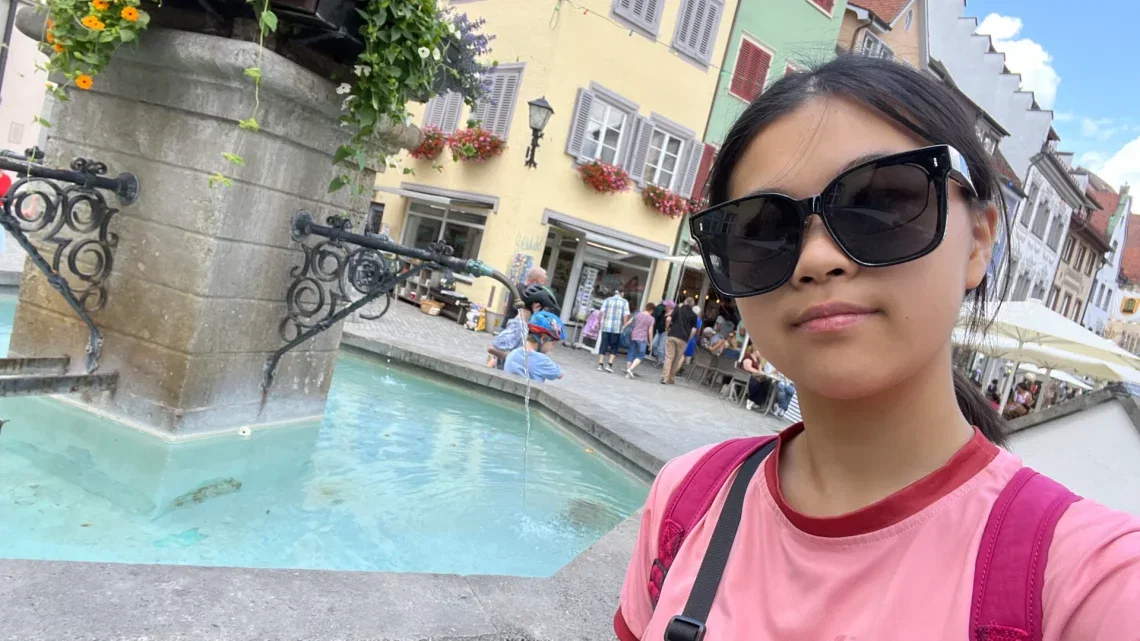
Our student Jasmine from Taiwan is 15 years old and is currently enrolled in a C1 German course in Lindenberg. At the end of the course, she will take the telc C1 Hochschule exam in Constance. In this interview, she tells us when she started learning German and what has helped her making such remarkable progress.
You’re still very young, but you already speak German at C1 level. How did you manage to achieve such a high level?
I first came to Bad Schussenried for a German course in 2023. Since my first course, I’ve been to Lindenberg three times and Bad Schussenried four times, and I’ve taken a total of 34 weeks of German courses at the Humboldt-Institut. With each visit, I’ve advanced by about one level. I’ve made the most progress here because I’m surrounded by German and can speak it every day.
In Taiwan, my German level stays more or less the same. I take a German class once a week, which helps a little. I also watch the Tagesschau [German TV news program] or message friends I met at the Humboldt-Institut, of course in German. Duolingo also helps me out a little with vocabulary, but not with grammar.
What helps you the most when learning, and is there a difference between the two course locations, Bad Schussenried and Lindenberg?
Especially at the higher levels, like B2 and C1, we speak almost exclusively German with each other, so we learn a lot from one another. Speaking German kind of comes naturally. We also learn more everyday language and can express ourselves more like native speakers. You notice these little changes in everyday life, too, when you hear how the counselors and staff members talk to each other and to us – and you realize that you actually understand everything!
I like both course locations equally. In the summer, Bad Schussenried is busier and there are lots of younger students. Sometimes they can be a little loud. But the ice cream shop in Bad Schussenried is better than the one in Lindenberg! For me, though, there’s no better or worse – both locations are great, and I really enjoy being at both.
When did you start learning German, what motivated you, and what do your parents think about it?
Actually my dad suggested that I learn German and go to Germany. I didn’t have any plans for my summer vacation, so I went with my best friend. At first, I was a little skeptical, but after my first summer in Bad Schussenried, I fell in love with Germany!
I’m still in touch with some of the classmates I met back then. It was fascinating to meet so many new people and experience different cultures. I also really liked the relaxed atmosphere in Bad Schussenried. Everything is less hectic than it is back home in Taiwan. These days, in the summer, I like to watch the sunset. In winter, when it gets dark early, I enjoy gazing at the beautiful night sky in Bad Schussenried and Lindenberg.
Here, I have time to live a little more slowly and relax. Just sitting outside and enjoying nature helps me clear my head. That’s a big difference from Taiwan’s stressful education system and life in a big city like Taipei.
What was the most difficult part of learning German for you?
I took private lessons for about a month before I first came to Germany. At that point, I was around A1/A2 level. At first, I couldn’t understand everything in class. But as my vocabulary grew, it got easier and easier. Vocabulary was the biggest challenge for me in the beginning. Grammar, on the other hand, wasn’t a problem. Maybe it helped that I already spoke English fluently.
Was there a moment when you realized, “No I can really speak German”?
Maybe it was last summer in Bad Schussenried, when we filmed the video “Learn German in Bad Schussenried”. The participating students had very different levels of German. While we were filming with the production team and the Humboldt-Institut staff, I realized just how well I could actually speak German by then. Even during our free time, speaking German started to feel more and more natural.
Now that I’m at C1, the topics are a little more complex and we’re learning lots of new vocabulary, for example when we talk about literature, art, politics, or psychology. The topics also become more varied as your level increases.
Sometimes it even happens at home in Taiwan. I’ll say “Doch!” during a discussion, and then my Taiwanese friends look at me completely confused because, of course, they don’t understand German. It just comes naturally. Sometimes I can only think of the German word for something and have no idea what that particular thing is called in English.
Besides “doch”, is there another German word or expression that you particularly like?
I think “doch” is really useful because there’s no equivalent word in English or Chinese. I also find “Zeitgeist” really interesting. I learned it in history class at school, where we used it to describe the spirit of a particular era. I’m always happy when I come across German words in everyday life. If I don’t know a word, I try to figure out its meaning myself. Sometimes my English helps when the words are similar.
What memories do you associate with your courses?
At Friday’s HIghlight parties, you always meet new people and get to know other students. Two years ago here in Lindenberg, I went to the parties with a friend from Turkey, and we danced and sang together a lot. It was so much fun, and I still love thinking back to those memories!
What I enjoy most is meeting new people through the language. In Taiwan, for example, I took part in a competition – the national qualifying round for the German Olympics/Deutscholympiade – and met lots of interesting people there. There aren’t that many people in Taiwan who learn German, and those who do often have many similar interests. One of my friends was then able to take part in the 2026 German Olympics in Mannheim.
Whenever I learn a new language, I feel like I’ve accomplished something, and that makes me happy. I like reaching new goals. Here at Humboldt, everyone supports each other and we all have the same goal: learning German. It’s such a friendly environment!
Also, all of my teachers are really nice, and the classes are very varied.
Do you think languages can change people? Why?
I think I’m influenced less by the language itself and more by the classmates I meet in class. Everyone comes from a different cultural background and has different ways of approaching things [Note: Students from 68 different countries take classes in Lindenberg]. When we discuss things together, I get to hear new perspectives and can let go of stereotypes. I think this opportunity that the courses at the Humboldt-Institut provide is fantastic.
What advice would you give to other young students who want to learn German?
I think especially when it comes to speaking, the most important thing is simply to speak. You shouldn’t be afraid of making mistakes – even our teachers make mistakes sometimes! [laughs]
When you’re learning about new topics and vocabulary, practice and actively use the new words so you don’t forget them so quickly. That’s what we do in C1 class, too. We use new expressions like “sich an die Arbeit machen” (“get to work”) or “etwas in Angriff nehmen” (“tackle something”) so that we can quickly add them to our vocabulary.
The same goes for new conjunctions and prepositions like “trotzdem” (“nevertheless”), “während” (“while”), or “wegen” (“because of”), especially when they’re used with the genitive case.
Do you already know what you’d like to do after high school?
After high school, I’d like to go to college and work in science, for example in biology or pharmacy. There are lots of opportunities in these fields in Germany. I find degree programs such as Molecular Biotechnology in Heidelberg particularly interesting! I’m also thinking about learning another language, maybe Italian or Korean.
Thank you for the interview, Jasmine! We wish you lots of success with your plans!